


- Disconnecting is vital for health: Taking a proper break resets cortisol levels, lowers long-term cardiovascular risk, and prevents severe burnout.
- Preparation beats anxiety: Writing a detailed handover, setting firm communication boundaries, and leaving your work laptop behind give you full permission to log off.
- Ditching your phone works wonders: Turning off work notifications or leaving your phone behind improves sleep, calms your mind, and restores work-life balance.
- Culture starts at the top: Managers who lead by example and respect leave boundaries help break the habit of constant work vigilance across the team.
How to switch off from work while on holiday: simple ways to leave the office blues behind
We've all been guilty of it. You're lying by the pool, trying your best to unwind, and suddenly, you let thoughts about unanswered emails, unassigned tasks, or missed deadlines slip into your mind. When you're supposed to be enjoying your hard-earned time off, figuring out how to switch off from work can feel like a job in itself.
If you can't stop opening notifications in between Piña Coladas, don't panic. We've pulled together this simple but effective guide on how to forget about work while you're away.
Why do people struggle with switching off from work?
If you find it hard to leave the office behind, don't worry — you aren't alone. On average, up to 84% of Brits find it difficult to disconnect from the world of work when they're on holiday. Because our jobs make up such a huge chunk of our lives, it's only natural that we think about them outside of working hours.
In our digital age, where most of what we do is online, and many are working remotely, that physical boundary between home and the workplace has practically disappeared. This puts more pressure on us to be available at virtually all hours of the day for quick email queries or a five-minute Teams call.
Ultimately, this creates a state of chronic vigilance. Your nervous system becomes so used to staying busy and alert that it actively struggles to wind down and disconnect when you're not working.
And sadly, this doesn't just magically end the second you step off the plane in your dream destination.
Why is it so important to detach work from time off?
It's important to enjoy your annual leave without being consumed by thoughts of your to-do list or what's waiting for you back in the 'real world'. But sadly, many find this a struggle because of unsupportive workplace cultures that make them feel guilty for taking this much-needed time away.
In fact, our Great British No-Break report found that over a fifth (21%) of Brits aren't taking their full annual leave allowance, and 42% admit their decision to take time off is heavily influenced by workload pressure and guilt.
If you don't properly draw a line in the sand, you're missing out on some vital health benefits. Taking a break gives you time for true psychological recovery, meaning you'll return to your desk with a boost in productivity, creativity, and focus.
Disconnecting is vital because it helps you:
- Reset your brain's cortisol (stress) levels.
- Lower your long-term risk of cardiovascular disease.
- Prevent burnout and improve work-life balance.
Our founder and director, Gary Bury, found that being overly connected to work wasn't productive for him when on holiday with his wife and kids, as he explains:
"Work was busy, stuff was happening, and I was getting the odd phone call here and there. One evening, my wife said, "Do you not mind getting calls while you are on holiday?" I said, "Not really, to be honest, I kind of accept it as part of being a Director." She paused, then said, "We mind."
"So the next time I went on holiday, just as we were leaving home, I switched my phone off, put it in my underwear drawer, and walked out of the house. Best thing I ever did, one week with no phone. I switched off quicker and paid more attention to my wife and kids. I was a better husband and father."
How to relax on holiday without work anxiety
If you want to properly relax on holiday, you'll need to lay a little groundwork before you actually log off. Here are a few practical steps you can take to keep work anxiety at bay:
Write a thorough handover
A smooth holiday starts with a great handover. You need to provide your team with everything they need to hold down the fort while you're away. Make sure you outline any outstanding tasks, explain exactly where completed projects are up to, and make a note of any communications that need to be monitored.
It's also a good idea to pre-emptively answer any questions your colleagues are likely to have. The key is to get this over to your team while you're still in the office, giving them time to flag anything you might've missed. Do this right, and you won't be harassed while you're trying to work on your tan.
Set strict boundaries around communication
You'll need to set firm boundaries with your team and managers around what they can expect from you while you're away. In an ideal world, you'll be completely unreachable. If that really isn't possible, make sure you clearly explain the specific, emergency circumstances where it's okay to contact you.
Don't forget to remind everyone about any time zone differences, too, so nobody expects you to answer a quick question in the middle of the night local time.
Turn off your notifications
It's tempting to have a 'quick glance' at your screen, but turning off your notifications for any work-related apps is a must while you're on holiday. Even if you aren't actively trying to do any work, just reading the first sentence of an email notification can lure you into opening the app, causing your anxiety to spike at the thought of a potential mistake or a mounting task list when you get home.
Create a clear out-of-office
Just like your handover, a clear out-of-office message makes it easy for anyone trying to reach you to know who to direct their queries to instead. This removes any lingering worries about emergency situations going unnoticed and heavily cuts down on the mountain of emails you'll have to wade through when you get back.
Leave your laptop at home
If you can, leave your work laptop at home. Knowing your laptop is sitting in your bag makes it tempting to check in when you have five minutes to spare.
Putting a physical boundary (and a literal ocean) between you and your work devices means you have no choice but to uncouple yourself from your job.
Set non-work-related goals during your holiday
One of the biggest reasons people end up drifting back into work mode is simply because they struggle to fill their time. You can easily avoid this trap by setting yourself a few fun, non-work-related goals.
Whether it's visiting a historic site, trying a new local dish, or finishing a novel, keeping yourself happily occupied helps fight the temptation to see what's happening at the office.
Should you leave your phone at home while on holiday?
Taking a break from your smartphone might sound scary, but it's one of the best things you can do for your mental wellbeing. According to one study, the average Brit checks their smartphone every 12 minutes!
Using up those precious annual leave days to go on holiday is one of the rare times you get to escape real life. Phones are like portals we stare into, sending our attention to another dimension until something snaps us out of it.
While there's nothing wrong with this from time to time, constantly reaching for your phone can be an indicator of something under the surface. Addiction issues often appear when we're burying something we don't want to think about.
This might be an opportunity to reflect on why you're so anxious to return to the electronic world so often – is there something you're avoiding? Can you talk about it or seek help? Be kind to yourself and take a moment to think about it.
What are the benefits of going phone-less?
We all know by now that the makers of mobile apps (social networks in particular) have one thing in mind, and it's not your wellbeing. Their profits depend on you spending as much time as possible on their platforms, looking at adverts. So, if anything, it's an act of rebellion to pry yourself away from their iron grasp.
Ditching your phone provides:
- Better sleep
- A calmer mind
- Closer relationships
- Increased enjoyment of leisure activities
A study published in the International Journal of Environmental Research and Public Health found that:
"Work-related smartphone use during non-work time drains limited regulatory resources and thus holds risks for wellbeing and subsequent self-control functioning. In order to protect themselves against these consequences, employees need to become aware of how long they actually use their smartphone for work during after-hours and, if necessary, reduce the intensity."
To state the obvious, tending to work matters on your smartphone when you're off the clock means you don't function right the next day. You'll be more moody, and your impulse control will be sorely lacking.
So, turn it off, lock it in the hotel safe, or, even better, leave it at home.
How to survive without your phone on holiday
If the thought of travelling without your digital safety net makes you break out in a cold sweat, there's no need to panic. Getting by without a smartphone is surprisingly easy with a few simple tweaks:
1. Use a camera
Modern compact cameras and DSLRs are the bee's knees. Phone cameras just aren't as good as proper ones, no matter how flashy the marketing videos look.
Camera makers have an incentive to make their cameras as good as possible with each release, but phone makers need to drag their innovations out, so they have things to talk about on the next annual upgrade. What next, four lenses on the back? Five?
The physical restraints of a flat phone mean you just can't achieve what a proper-sized lens can. Using a camera makes you more conscious of proper framing and lighting, meaning you'll come back home with some high-quality shots you can be proud of.
Or, for a different approach, get your holiday companions to take the photos instead.
2. Use a notebook
Even if you haven't used a pen in years, it's worth picking up a notepad and jotting down whatever you'd normally want to type into a smartphone while you travel:
- Thoughts and reflections on life
- Things you want to say to people
- Memories and journals of your travels
- Ideas that come to you in the middle of the night
- To-dos that need doing
The notebook you choose doesn't have to be fancy. In fact, the expensive notebooks tend to put you off writing in them as you don't want to 'ruin' them with casual scribbles. Instead, pick up a simple, waiter's notepad in a stationery shop — you can get one for about £2.
3. Print out all of your travel essentials
Flight tickets, train tickets, travel directions, all kinds of things are mobile-first these days. But they're rarely mobile-only, and many providers will still take paper tickets. Take a few minutes to print them off before you travel, and you're good to go.
What happens when you don’t switch off properly?
We know that thousands of workers aren't switching off when they should be. But what's the actual fallout when you, or your team, refuse to disconnect?
A 2018 meta-analysis (a study of previous studies) published in the International Journal of Management Reviews sheds an interesting light on what they call voluntary ICT use during non-work time. After looking at 54 different examples, researchers found that basically all of it led to negative outcomes, with stress and poor mental wellbeing being the most common result of workers staying connected to work when they didn't need to.
Can employers be doing more to encourage switching off?
On whether or not employers should restrict communications while employees are on holiday, the researchers' answer is basically — we're not sure. Some employers try initiatives like blocking company-wide emails for those on leave, but it's rare to find the results of these programs.
What the researchers found is that staying 'connected' during non-work time was almost always voluntary, meaning managers didn't demand it, but subtle cultural forces meant people felt peer-pressured into doing it.
According to the researchers, "This further emphasises the demand for self‐management, which is embedded in a supportive organisational culture."
There's no one-size-fits-all solution, but one thing is for sure: Encouraging your staff to switch their phone off when they're away means they'll come back more rested, happy, energetic, and ready to get back to work.
What is the ‘holiday paradox’?
Have you ever noticed that time seems to play tricks on you while you're away? When you're lounging by the sea, the days feel long and relaxed. But the second you're back at your desk reminiscing, the trip feels like it passed in the blink of an eye. This weird, disorienting shift in pace is known as the 'holiday paradox'.
The neuroscientist Daniel Kahneman explains this as a disconnect between our 'experiencing self' and our 'remembering self'.
Essentially, the brain selects what it wants to remember and what it wants to discard. While you're aware of time passing in the moment, looking back on a long, unbroken stretch of relaxation can feel brief in your memory.
According to psychology writer Claudia Hammond, we view time prospectively and retrospectively. Usually, these match up through our daily routines — like alarm clocks, commuting, and standard bedtimes. But on holiday, those regular markers of time vanish. You're thrown into a buffet of new sights, sounds, and routines.
Without your usual schedule to anchor you, your brain loses its grip on time, making the shift back to the fast-paced office feel abrupt and jarring.
How to remember more of your holidays
So, how do you make those amazing holiday memories stick around a little longer so you don't feel quite so jolted when you return to reality?
Memory is fuzzy, weird, and deeply linked with your emotional state.
If we have two experiences that are basically the same, it'll always be difficult to remember them as separate events — especially if you weren't in a heightened emotional state at the time.
If you spend your whole holiday on the same deckchair every day, letting time pass, you'll have a hard time remembering it because there are no memorable events or milestones during that time. That means, even if it seemed like a long time while you were experiencing it in the moment, when you look back, it'll seem much shorter.
Maybe, Claudia Hammond suggests, you need to liven things up a bit to appreciate them afterwards. She says, "You're most likely to remember the timing of an event if it was distinctive, vivid, personally involving and is a tale you have recounted many times since."
Sounds like a good excuse to go skydiving. Or maybe sit on a different deckchair each day, at least.
Manage your holiday with Timetastic
Switching off from work takes self-discipline, but having the right tools in place makes it much easier. When your business has a clear view of who's off and when, nobody has to panic about scheduling clashes or missed shifts.
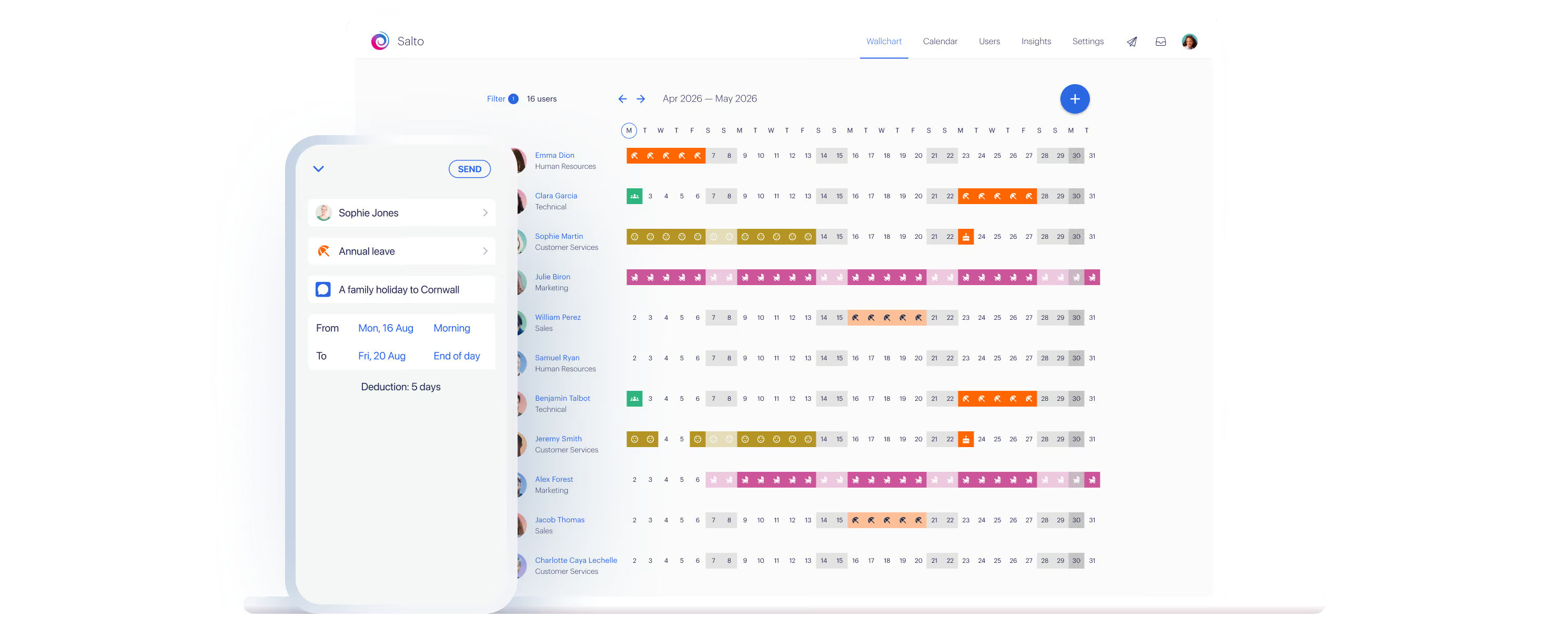
With our simple staff leave planner and user-friendly absence management software, keeping track of annual leave is a breeze. You can ditch the messy spreadsheets and replace them with an intuitive wall chart, making sure everyone gets the well-deserved, uninterrupted downtime they need.
FAQs
How do I stop worrying about work while on holiday?
The best way to stop worrying is to prepare properly before you log off. Write a thorough handover for your team, set a clear out-of-office message, and make sure someone is covering your key responsibilities. Once you leave, turn off all work notifications on your phone or delete your work email app entirely. If you want a smooth departure, take a look at our checklist on what to do before you leave the office on holiday so you can walk away with complete peace of mind.
Can my boss legally contact me while I'm on holiday?
While there isn't an explicit law banning employers from making contact, you aren't required to work or check communications while taking your statutory annual leave. To protect your downtime, set firm boundaries with your manager before you go and define what counts as an emergency. As awareness around employee burnout grows, more businesses are adopting the right to disconnect policies to make sure staff enjoy uninterrupted rest.
How long does it take to mentally switch off on vacation?
It usually takes most people two to three days for their stress levels to drop and for work thoughts to fade away. That's why short weekend trips often feel like they fly by before you've had time to relax. If you're trying to figure out how much time off you need for proper psychological recovery, reading up on what the ideal length of a holiday is can help you plan trips that give your brain time to fully reset.
How can employers help their team switch off while on leave?
Culture starts at the top. Managers need to lead by example by not checking in or sending emails while they're on holiday themselves. Employers should also respect boundaries by not messaging staff who are on leave and making sure workloads are covered fairly before anyone logs off. Managers looking to build a healthier culture around leave can explore our guide on encouraging time off across the business.

Feature photo by Patrick Robert Doyle on Unsplash





200,000+ people book their time off here
Set it up for your team before the next request lands.