


What is paternity leave? A guide to rights, rules, and pay
Paternity leave has long felt like the "poor relative" of family leave; short and poorly paid. But the workplace is changing, and so is the law.
We're moving away from the idea that raising a child is "mum's job" while the other partner heads back to work after a few sleepless nights. Modern employees expect more support, and businesses that provide it attract the top talent.
But staying on top of the rules can be tricky, especially with big changes to employment rights on the horizon in 2026.
Whether you're looking to update your company's time off policy or an employee has shared their happy news, and you’re unsure what this means for you, don't panic. We'll cover everything you need to know, from rights to new regulations — helping you support your team without getting bogged down in jargon.
What is paternity leave?
Simply put, paternity leave is a planned absence from work after the birth of a child, giving the employee time to support the mother or primary caregiver and care for their new baby.
It's important to remember that, while the name "paternity" implies "father", the legislation is inclusive; it's not just for biological dads.
Paternity leave also applies to:
- The husband or partner of the mother (or adopter)
- The child's adopter
- The intended parent (if having a baby through a surrogacy arrangement)
This also includes same-sex partners. As long as they are an employee and responsible for the child's upbringing, they're likely entitled to take this time off.
Who is eligible for paternity leave?
To qualify for statutory paternity leave, a person needs to meet a few specific criteria.
They need to be:
- An employee (with an employment contract)
- Responsible for the child's upbringing
And, either:
- The biological father, the mother's husband/partner, or the adopter
If a couple is adopting, one person takes adoption leave, and the other takes paternity leave. They can choose who takes which.
It's also important to remember that, if an employee sadly loses their baby (such as via miscarriage or stillbirth) after 24 weeks of pregnancy, they're still entitled to full paternity leave and pay.
For paternity leave to be authorised, the employee has to notify you that they plan to take leave and set out a clear timeline for when they'll be away and when they intend to return.
When does paternity leave start?
The short answer is: it can't start before the baby is born.
Usually, paternity leave starts on the day of the birth or the day after. However, babies are famously bad at sticking to schedules. Your employee might have booked a specific start date for their absence, but if the baby arrives early, their leave does too.
An eligible employee can also choose to start their leave a specific number of days after the birth, or on a specific date after the expected week of childbirth. But it's important to note that this leave can't be taken more than 56 days after the child's birth.
Notice periods and Day One Rights
Previously, employees were held to a notice period that said they needed to have worked for you for 26 continuous weeks (6 months) by the time they reached the 25th week of pregnancy to qualify for paternity leave.
However, under the new Employment Rights Bill introduced in 2025, the government is making paternity leave a 'Day One' right. This means that from April 2026 onwards, employees will be eligible for statutory paternity leave from their very first day of employment, removing that 26-week hurdle.
Despite these eligibility changes, employees will still need to give you proper notice.
How can an employee claim paternity leave?
If an employee wants to take their paternity leave, they have to tell you:
- The baby's due date
- Roughly when they want their leave to start
- How much leave they want to take
They need to let you know this by the 6th month of the pregnancy. However — and this is where it gets a bit more flexible — they only need to give you 28 days' notice of the actual dates they intend to take. This lets them adjust their plans if circumstances change.
How long is paternity leave in the UK?
Eligible employees can choose to take either 1 or 2 weeks of paternity leave.
The rules on how they take this leave have become much more flexible in recent years. Previously, paternity leave had to be taken in one solid block. If they only took one week, they lost the second. Now, employees can choose to take their two weeks together or split them into two separate one-week blocks.
They also have a much wider window in which to use it. They can take the second week of leave at any point within 52 weeks of the birth (or placement, for those adopting). This is great for families who want the partner to be around to offer support immediately after the birth, and then save a week for later in the year when the mother or main adopter returns to work.
Does paternity leave include weekends?
Paternity leave is calculated in weeks, not individual days. A "week" of leave is a block of 7 days, including weekends.
For example, if an employee usually works Monday to Friday and starts their leave on a Monday, their leave finishes on the following Sunday. So they'll be expected back at work on Monday morning.
If they work a shift pattern that includes weekends, those working days are covered by the leave period. They can't just take "5 days off" to cover their shifts and save the weekend days for later; it has to be a 7-day block.
Is paternity leave paid? (And how much?)
Paternity leave is paid, provided the employee earns at least the Lower Earnings Limit for National Insurance (currently £125 a week) and meets the eligibility criteria.
Statutory Paternity Leave is paid at a fixed rate set by the government, or 90% of the employee's average weekly earnings — whichever is lower. As of April 2025, the statutory paternity pay rate is £187.18 per week. This is reviewed every April, so keep an eye on government updates for the 2026/27 tax year.
To put this into perspective, if your employee earns £500 a week, they will receive the statutory rate (approx £187.18). If they earn £150 a week (which is less than the statutory cap but more than the lower earnings limit), they will receive 90% of their £150 earnings (approx £135).
Is paternity leave full pay?
A common misconception is that employees will receive their full salary while on paternity leave. Unfortunately, this pay is statutory, which means it's often significantly lower than their standard salary.
However, many forward-thinking businesses choose to offer enhanced paternity leave. Such companies top up the statutory amount to match the employee's full salary, or at least a higher percentage of it.
Other types of leave for partners
If your employee is asking how much paternity leave fathers are entitled to in the UK, regulations generally cap it at two weeks. However, there are a few other routes they can take if they need more time:
Shared Parental Leave (SPL)
If the mother or primary parent decides to end their maternity or adoption leave early, they can "convert" the remaining weeks into shared parental leave.
These parents can share up to 50 weeks of leave and 37 weeks of pay between them, as long as they're both in steady employment (and have been for 26 weeks+) and earn at least £120 a week. It's a great way for partners to take a more extended period off work.
It's a bit more admin-heavy than standard paternity leave, and requires at least 8 weeks' notice of exact dates to be taken as leave, but it offers families much more flexibility.
Check out our guide to sharing parental leave for more information.
Unpaid Parental Leave
If an employee has used their full paternity entitlement but still needs more time to look after their children, they might be eligible for unpaid parental leave.
Eligible employees (with at least one year's continuous service) can take up to 18 weeks of unpaid leave for each child, up to the child's 18th birthday. The limit is usually 4 weeks per child, per year. This leave is fully unpaid, so it's not always a viable option for every employee, but it's a statutory right that offers a safety net for childcare issues or simply spending more time together.
Learn more about taking unpaid leave in the UK with our guide.
Bereaved Partner’s Paternity Leave
Compassionate support is essential when things go wrong.
While paternity leave still applies if a baby is stillborn after 24 weeks, the government has also introduced the Bereaved Partner's Paternity Leave to strengthen rights for bereaved partners where the mother has passed away during or within 52 weeks of the birth, meaning they can take extended leave to care for the child.
What about paternity leave for self-employed workers?
Unfortunately, the strict rule is that statutory paternity leave and pay are for employees only. This means that, if someone is a sole trader, freelancer, or contractor (classed as a "worker" rather than an employee), they typically don't qualify.
Self-employed mothers can claim Maternity Allowance, but sadly, there isn't a direct "Paternity Allowance" equivalent for fathers or partners at this stage. This is a gap in the system, meaning self-employed partners often have to take unpaid time off or save up in advance to cover their break.
Why you should encourage (and enhance) paternity leave
If you're a business owner, you might look at paternity leave as just another cost or a scheduling headache. But there are surprising benefits to encouraging your employees to utilise their time off.
Currently, uptake is fairly low, with around 59% of eligible employees opting to use their leave. Research often shows that financial worry is the biggest barrier — many families simply can't afford for the higher earner (which statistically tends to be the male partner) to drop down to just £187 a week.
By offering enhanced paternity leave (e.g., full pay for two weeks), you are:
- Closing the gender pay gap — Working mothers typically have to drop their hours from 40 to under 30 following the birth of a child, damaging their career progression. When fathers take more leave, mothers are more likely to return to work without reducing their hours.
- Boosting staff retention — Employees remember who supported them when their life circumstances changed. If you support them with the leave they need now, they're less likely to jump ship for a competitor later, or submit a flexible working request to continue childcare while on the clock.
- Improving employee mental health — Burnout is real, and new parents are exhausted. Giving them the time and space needed to bond without financial panic makes for a happier, more focused employee when they return.
Managing paternity leave with Timetastic
Between newly-introduced "Day One" rights, varying notice periods, and shared parental leave, keeping track of who's off and when can be a challenge.
If you're still using a spreadsheet to track employee absences, you're making life harder than it needs to be. Spreadsheets don't remind you when notice periods are due or give the team full visibility on who's in the office next week.
That's where Timetastic is a game-changer.
With our simple-to-use software, you'll be able to:
- Replace the messy paperwork with a simple, clean system.
- Create a specific "Leave Type" for Paternity Leave.
- Upload supporting evidence documents securely to your employee profiles.
- Plan absences into a shared calendar that syncs with Teams, Slack, and more.
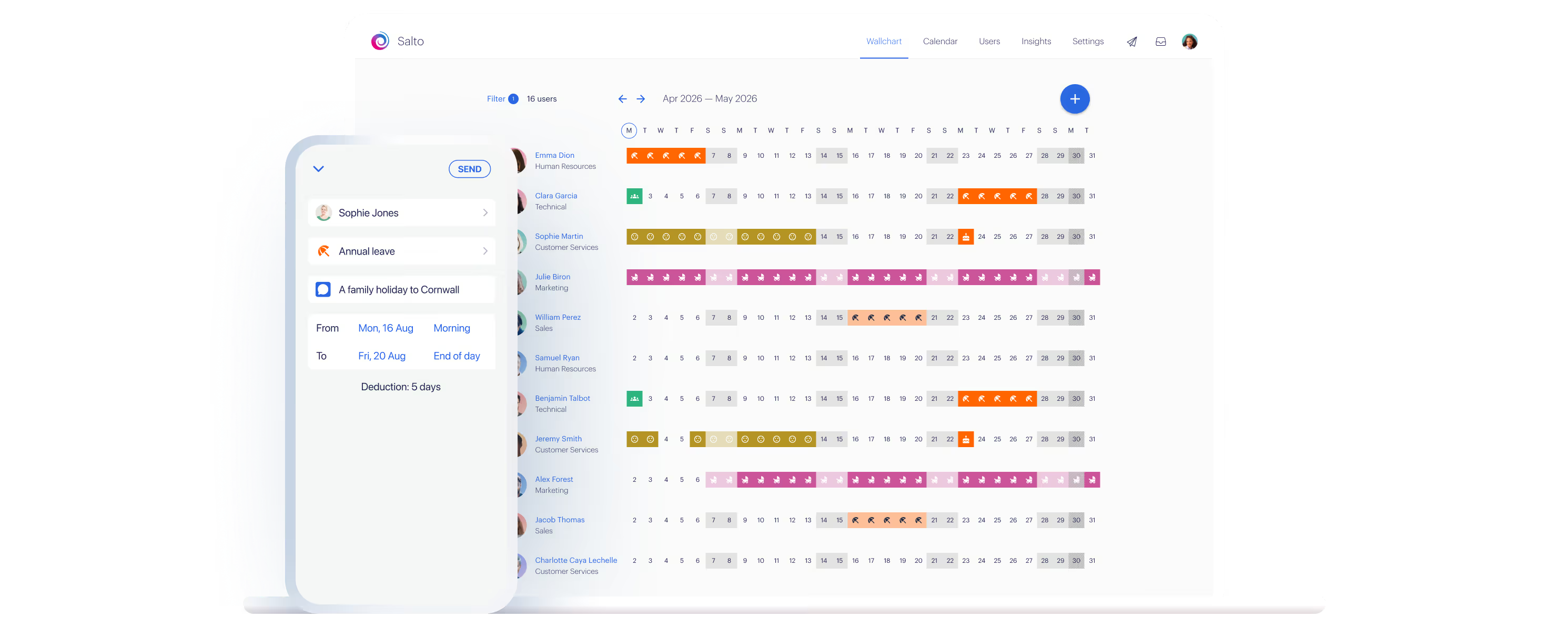
- See all employee absences at a glance on your Wall Chart.
Ready to simplify your staff leave? Start your free trial today or contact us for more information.



200,000+ people book their time off here
Set it up for your team before the next request lands.